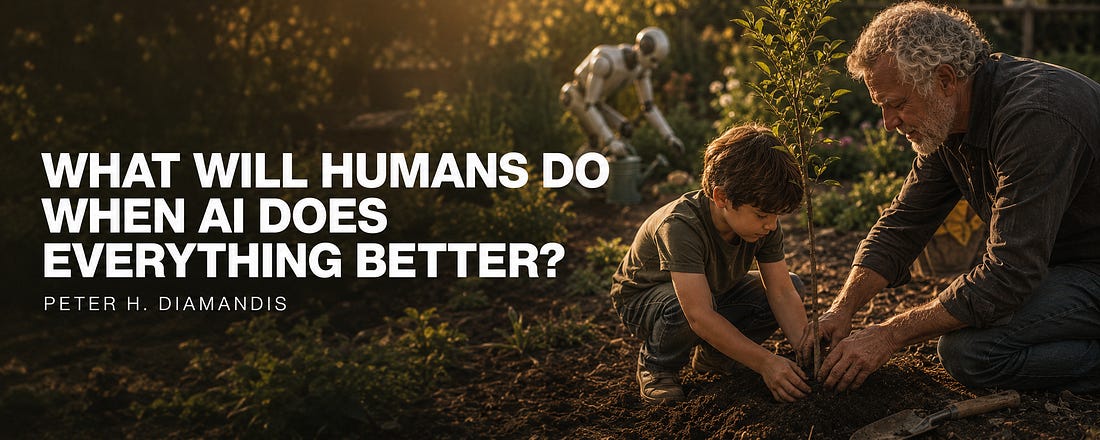
What Will Humans Do When AI Does Everything Better?
A Brainstorm on Purpose, Meaning, and the Post-Work Future
 |
THE QUESTION
When AGI can do any cognitive task better than any human, and humanoid robots can do any physical task better than any human, what is left for us? Not economically. Existentially. What gives a human life meaning when there is nothing a human must do that a machine cannot do better?
This is not a question about unemployment. It is a question about purpose. The unemployment problem has a policy answer (universal high income, redistribution, infrastructure). The purpose problem does not. It is the deepest philosophical question of the AI age, and almost nobody is seriously working on it. This document is a first attempt.
“Technology is the means by which humanity takes a vacation from survival”
– Sadguru
HISTORICAL PRECEDENT 1: THE GREEK CONCEPT OF SCHOLÉ
The ancient Greeks had a word for what we are approaching: skholé (σχολή). It is the root of our words ‘school’ and ‘scholar.’ But skholé did not mean school as we know it. It meant freedom from labor, dedicated to intellectual and spiritual pursuit. For the Greek aristocracy, work was for slaves and metics. The citizen’s highest calling was skholé: philosophy, politics, athletics, art, conversation, the Olympic games, the symposium.
Aristotle wrote that ‘we work in order to have leisure.’ Leisure was not idleness. It was the most serious business of life. The Greek word for leisure became the word for intellectual pursuit because the Greeks understood something we have forgotten: the highest human activities are those done for their own sake, not for survival.
The post-AGI world is the democratization of skholé. For the first time in history, everyone can be a scholar, an athlete, a philosopher, an artist. Not because they are aristocrats, but because the machines handle survival. The question is whether we will use that freedom like the Greeks did or like the Romans did (bread and circuses).
HISTORICAL PRECEDENT 2: THE RENAISSANCE PATRON
The Medici family spent 633,000 florins between 1434 and 1471 on patronage. That is roughly $500 million in today’s money. They funded Brunelleschi’s dome, Botticelli’s paintings, Michelangelo’s sculptures, Galileo’s science, and the Platonic Academy in Florence. They did not create the art themselves. They created the conditions for art to exist.
The Renaissance aristocrat did not work in the way we understand work. Their ‘job’ was to be a patron: to identify talent, fund it, protect it, and curate the results. Lorenzo de’ Medici was not a painter or a sculptor. He was a curator of human genius. His purpose was not to produce but to enable, to choose, to direct resources toward the beautiful and the true.
In the post-AGI world, the role of the patron is available to everyone. AI produces. Humans curate. The question ‘what should we build?’ becomes more important than ‘how do we build it?’ The Medici model suggests that curation, patronage, and taste are not lesser activities. They are the activities that created the Renaissance.
HISTORICAL PRECEDENT 3: HOW THE ULTRA-WEALTHY SPEND TIME TODAY
Harvard Business School research on millionaires found that the wealthy spend more time on active leisure (exercise, volunteering, socializing, reading) and less on passive leisure (TV, scrolling) than the general population. The JPMorgan report on ultra-wealthy families identified reading as the single most common habit. Here is how the ultra-wealthy actually spend their days:
• Physical optimization: Personal trainers, golf, tennis, sailing, yoga, home gyms. The body as a project.
• Intellectual pursuit: Reading (the #1 cited habit), writing, learning languages, collecting knowledge.
• Patronage and philanthropy: Funding foundations, museums, universities, scientific research. The Medici impulse persists.
• Curation and collecting: Art, wine, watches, cars, real estate. The act of choosing and assembling.
• Social connection: Dinner parties, clubs, travel with family, mentoring. Deep relationships as the core reward.
• Creative expression: Painting, music, writing, filmmaking. Not for money. For the act of creation itself.
• Exploration: Space tourism (Bezos, Branson), deep sea exploration, extreme sports, adventure travel.
• Spiritual practice: Meditation retreats, philosophical study, religious engagement, seeking meaning.
• Competition: Chess, poker, racing, betting. The drive to test oneself against others, even when money is irrelevant.
• Mentoring and legacy: Passing knowledge to children, building institutions, writing memoirs.
Notice what is absent from this list: none of these activities are ‘work’ in the economic sense. None are done for survival. All are autotelic: done for their own sake. The ultra-wealthy have already arrived at the post-work destination. They are our preview of what everyone will do when AGI removes the necessity of labor. The data suggests they are not bored or purposeless. They are the busiest, most engaged people on Earth. They just are not doing it for money.
10 CATEGORIES OF POST-AGI HUMAN PURPOSE
Drawing from historical precedent, flow psychology, and years of working through this question with the Abundance360 community, here are 10 categories of activity that will give us purpose when AGI can do everything better:
1. THE CURATOR (The Medici Role)
When AI can produce anything, the most valuable human skill is deciding what should be produced. Curation is an act of taste, values, and vision. AI can generate 10,000 images, 10,000 business plans, 10,000 scientific hypotheses. The human decides which ones matter. This is not a lesser role. It is the role that created the Renaissance.
Commissioning art, science, and exploration from AI systems
Curating knowledge: assembling, organizing, and interpreting what AI produces
Setting priorities: deciding which problems AI should solve first
Taste as the new intelligence: the human who knows what is good, beautiful, and true becomes more valuable than the one who knows how to make it
2. THE EXPLORER
AI can process data faster, but humans still want to stand on the mountain. The experience of discovery is not the same as the fact of discovery. AI can map the ocean floor. A human still wants to dive to it. AI can calculate the atmosphere of Mars. A human still wants to walk on it.
Space exploration: the human drive to go where no one has gone, even when AI has already been there
Deep sea, polar regions, caves: physical exploration of Earth’s remaining frontiers
Inner exploration: meditation, psychedelics, consciousness studies, the exploration of subjective experience
AI can tell you what is there. Only you can experience being there. The experience is the point.
3. THE ATHLETE (Mental & Physical)
When chess engines surpassed human chess players in 1997, more people played chess than ever before. When AI drives cars better than humans, more people will drive cars for pleasure. The point of sport is not to be the fastest. It is to test yourself against your own limits. AI being better does not diminish the experience. It liberates it from the pressure of competition for survival.
Physical sports: the body as instrument, pushed to its limits for the joy of mastery
Mental sports: chess, poker, strategy games, competitive programming (against other humans)
Esports and competitive gaming: human-vs-human competition, even when AI is superior
The Olympics as the model: we do not watch because humans are the fastest possible. We watch because a human achieved something extraordinary.
4. THE CREATOR (Amateur in the Original Sense)
‘Amateur’ comes from the Latin amare: to love. The amateur creates for love, not money. In the post-AGI world, everyone is an amateur. AI produces better art, better music, better writing. But humans will still create because the act of creation is itself the reward. Csikszentmihalyi’s research on flow shows that the deepest happiness comes from autotelic activity: activity that is its own purpose.
Painting, sculpture, music, writing: not to compete with AI, but for the flow state of creation
Gardening, cooking, craftsmanship: making things with your hands for the satisfaction of making
Building physical things: woodworking, pottery, textile arts. The hands want to work even when the mind doesn’t need to.
The journey is the destination. AI produces the result. The human experiences the process.
5. THE RELATIONSHIP BUILDER
AI can simulate empathy. It cannot be a friend. The deepest human need is connection with other consciousnesses. In the post-AGI world, relationships become the primary currency. Not because nothing else is valuable, but because relationships are the one thing that cannot be outsourced to a machine.
Deep friendship: the kind that requires decades of shared experience
Family: raising children, grandparenting, family traditions, intergenerational knowledge transfer
Community building: creating and maintaining social fabric, neighborhoods, cultural groups
Mentoring: passing wisdom (not information) to younger generations
Love: the most irreducibly human experience. AI can simulate it. It cannot live it.
6. THE PHILOSOPHER
The Greeks invented philosophy because they had skholé. When survival is handled, the deepest questions become the most urgent. What is consciousness? What is good? What is beautiful? What should we want? AI can answer ‘what is.’ Humans must answer ‘what should be.’ The philosophical question becomes the engineering question in the post-AGI world.
Ethics: what should AI be allowed to do? What should we want it to do?
Aesthetics: what is beautiful? What is worth creating?
Meaning: what is a good life? What is worth living for?
Governance: how should we organize society when labor is unnecessary?
The unexamined life becomes the only life worth examining when survival is guaranteed.
7. THE PATRON AND PHILANTHROPIST
The Medici model scaled to everyone. In a world of abundance, everyone has resources to direct. Patronage becomes a universal activity: identifying what deserves support, funding it, watching it grow. The XPRIZE model: incentivizing the outcomes you want to see in the world.
Funding science, art, exploration, and social causes (even at small scale)
Incentive prizes: designing competitions that direct AI and human effort toward meaningful goals
Angel investing in human creators: backing the people who still want to make things by hand
The democratization of patronage: crowdfunding at scale, directed by human taste not algorithmic optimization
8. THE STORYTELLER
AI can generate stories. But stories are not about the text. They are about the shared experience of meaning-making. A story told by AI is data. A story told by a human to other humans is connection. The campfire does not become obsolete because we have electric lights. We still sit around it.
Personal narrative: sharing lived experience, memoir, oral history
Myth-making: creating the stories that give a community its identity
Humor: comedy is the most irreducibly human art form. AI can write jokes. It cannot understand why they are funny.
The human story: interpreting and narrating the experience of being human in an age of machines
9. THE PARENT AND EDUCATOR
Fei-Fei Li told Huberman: ‘I always have hope for kids. They are curious.’ In the post-AGI world, education is not about information transfer (AI does that better). It is about character formation, value transmission, and helping children discover what they love. The Socratic method becomes the only pedagogy that matters.
Raising children: not to be workers, but to be full humans
Teaching wisdom, not knowledge: AI has knowledge. Humans have wisdom about what to do with it.
Character education: courage, kindness, resilience, curiosity. These cannot be trained by AI.
The parent as guide: helping children navigate a world where anything is possible, which means the skill of choosing becomes paramount
10. THE HEALER
AI will diagnose better than any doctor. Robots will perform surgery better than any surgeon. But healing is not the same as curing. Healing is the human act of being present with suffering. A nurse holding a hand. A friend sitting with the dying. A community rallying around the broken. AI can cure. Only humans can heal.
Emotional healing: presence, listening, empathy, the human warmth that no algorithm replicates
Community care: building support systems for the vulnerable
End-of-life companionship: the most human of all activities, being with someone as they die
Spiritual care: tending to the soul, however defined, in a world where the body is handled
THE FLOW ARGUMENT: WHY BEING WORSE THAN AI DOESN’T MATTER
Csikszentmihalyi’s research on flow states reveals something critical: the deepest human happiness comes from activities where challenge matches skill, where attention is fully absorbed, and where the activity is autotelic (done for its own sake). Flow is not about being the best in the world. It is about being fully alive in the moment.
A runner does not stop running because a car is faster. A chess player does not stop playing because Stockfish is better. A painter does not stop painting because AI generates images in seconds. The experience of mastery, of flow, of being fully present in the act, is not diminished by the existence of something better. It is liberated from the need to compete.
This is the key insight: the post-AGI world does not eliminate human purpose. It eliminates the confusion between purpose and productivity. For 10,000 years, we have equated meaning with work because work was necessary for survival. When survival is guaranteed, we can finally discover what meaning actually is. And the answer, based on every historical precedent from ancient Greece to the modern ultra-wealthy, is that meaning comes from autotelic activity: things done for their own sake, with full presence, in community with others.
THE DANGER: BREAD AND CIRCUSES
The Roman aristocracy also had skholé. They chose bread and circuses. Gladiator combat, chariot racing, vomitoriums, and decadence. The Greeks used leisure to create philosophy, democracy, and the Olympics. The Romans used leisure to entertain themselves to death. The same freedom produced civilization in one case and collapse in the other.
The post-AGI world faces the same fork. On one path: universal skholé. A world of philosophers, artists, athletes, explorers, patrons, and relationship builders. A second Renaissance, but this time for 8 billion people. On the other path: universal bread and circuses. Endless AI-generated entertainment, dopamine optimization, virtual reality escapism, and the slow atrophy of human capability.
The difference between the two paths is not technology. It is culture. It is what we value. It is what we teach our children. It is the stories we tell about what a human life is for. The Greeks had Homer. The Renaissance had Petrarch. What stories will we tell in the post-AGI age?
THE ABUNDANCE FRAME:
This question connects directly to the ‘When We All Become Wealthy’ newsletter I sent out last week. The millionaire lifestyle demonetizes by 2031. But the question that newsletter didn’t answer is: once everyone has the millionaire lifestyle, what do they DO with it? The ultra-wealthy today give us the answer: they pursue health, relationships, learning, patronage, exploration, competition, creation, and spiritual growth. Not because they have to. Because those are the activities that make a human life feel meaningful.
The abundance thesis has always been about more than material goods. It is about the liberation of human potential. When survival is handled, when health is optimized, when intelligence is free, the question shifts from ‘how do we survive?’ to ‘how do we flourish?’ That question has been answered by every civilization that achieved leisure: the Greeks, the Renaissance Italians, the Enlightenment philosophers, and today’s ultra-wealthy. The answer is always the same: pursue what you love, build relationships, create beauty, explore the unknown, and seek wisdom.
These are the challenges my Abundance360 members are already building for. And let me be clear, the post-AGI world is not the end of human purpose. It is the beginning. For the first time, everyone gets to answer the question: what would you do if you could do anything? The answer to that question, multiplied by 8 billion people, is the most exciting future I can imagine.
To a future of abundance,
Peter

No comments:
Post a Comment