https://scitechdaily.com/scientists-develop-a-clever-new-way-to-kill-cancer-cells-from-the-inside/
Monday, October 26, 2026

Sunday, October 25, 2026
AI Just Took a MASSIVE Leap Towards Becoming Human
Yeah, we should arrange for a safe word to prove it's us on the phone.
Friday, October 23, 2026
We’re Already Inside It (the Singularity)
The Singularity is here. And that robot is pretty terrifying.
Tuesday, October 20, 2026
Saturday, October 17, 2026
Friday, October 16, 2026
This AI Reconstructs What You’re Looking at From a Brain Scan
Whoa, that’s impressive…and could get invasive.
https://singularityhub.com/2026/10/12/this-ai-reconstructs-what-youre-looking-at-from-a-brain-scan/
Wednesday, October 14, 2026
Monday, October 12, 2026
Scientists Discover an Unexpected New Way To Fight Alzheimer’s Before It Starts
“We also found that females with APOE4 saw the greatest improvement in brain blood flow, which is significant given that nearly two-thirds of people with Alzheimer’s are women”
Saturday, October 10, 2026
This Tool Turns Scientific Articles Into Agents That Answer Questions and Collaborate
This will accelerate scientific knowledge dramatically, I think.
Friday, October 9, 2026
ChatGPT nuance and banter
I had a picture of a character in my Western named Karen McIntyre whom I wanted to look more arrogant, so I asked GPT to that. It did the picture well, adding the commentary, "I raised Karen's chin and gave her a cooler, more appraising expression. She reads as more arrogant without looking theatrical."

I thought that showed an extra touch of nuance, and for fun I replied, "Her name is Karen, after all."
GPT replied, "And this Karen doesn't ask to speak to the manager. She tells him what to do."
Plenty of humans wouldn't get the Karen reference at all, and very few would come back with that level of banter.
I just found that impressive. And GPT is the least clever it will ever be from now on.
Wednesday, October 7, 2026
Aging Cells May Be Hiding From the Immune System – Scientists Think They Know How
Fixing that could dramatically increase lifespans and healthspans.
Monday, October 5, 2026
Sunday, October 4, 2026
Saturday, October 3, 2026
Wednesday, September 30, 2026
Tuesday, September 29, 2026
A Lab Published How Much of Its Research the AI Now Runs
It’s weird that I remember reading 23 years ago that this would happen about now.
Monday, September 28, 2026
Friday, September 25, 2026
DNA Has a Four-Letter Alphabet. Scientists Just Expanded It to Eight
Considering all the variations of life evolution has been able to create with just 4 letters…what orders of magnitude more might 8 result in?
I had to ask GPT. It said this: “So for something the length of a modest 1,000-base gene, an eight-letter alphabet has about 301 additional orders of magnitude of possible sequences.”
Holy crap!
Thursday, September 24, 2026
Monday, September 21, 2026
Sunday, September 20, 2026
Canada's New Invention Could Replace Solar Panels Forever
Perovskites are finally making it into production. Just add it as a thin film over your existing solar panels to significantly boost production. Nice!
Saturday, September 19, 2026
Wednesday, September 16, 2026
The cost of intelligence is collapsing faster than anything in the history of technology
“The cost of intelligence is collapsing faster than anything in the history of technology. According to the Stanford HAI 2025 AI Index Report, the cost of querying an AI system performing at GPT-3.5 level dropped from $20.00 per million tokens in November 2022 to just $0.07 per million tokens by October 2024. That is a 280-fold reduction in approximately 24 months. For the price of a coffee, anyone can now command research capability that five years ago would have required a team of specialists and millions in capital. The barrier to creating, building, and launching has been effectively removed.”
Sunday, September 13, 2026
Major Trial Tests a New Way To Decide Who Really Needs Statins
This comes out right after I finish my CT scan:
https://scitechdaily.com/major-trial-tests-a-new-way-to-decide-who-really-needs-statins/
Wednesday, September 9, 2026
Unitree Breakthrough: The World’s First Fully Autonomous Humanoid Robot Combat
Well, I certainly never predicted that robots would learn how to shin kick like we do in Muay Thai!
Saturday, August 29, 2026
World's Largest Electric Plane Just Flew — On $5 of Electricity
I can’t wait to not have to smell that nasty jet fuel when boarding a plane anymore.
Friday, August 28, 2026
Tuesday, August 25, 2026
I Gave AI a Body and It Became Sentient?!
This gives us a clear hint of where the convergence of AI and robotics will take us, even if this is a rather limited experiment. Robots won’t be those clunky, monotone-voiced machines from old science fiction, because the mind and personality are developing before android bodies.
Saturday, August 22, 2026
Thursday, August 20, 2026
Moderna and Merck say melanoma vaccine succeeded in large trial
Good news for Piglit, should any recurrence occur.
https://www.cnn.com/2026/08/19/health/moderna-merck-mrna-melanoma-vaccine
Wednesday, August 19, 2026
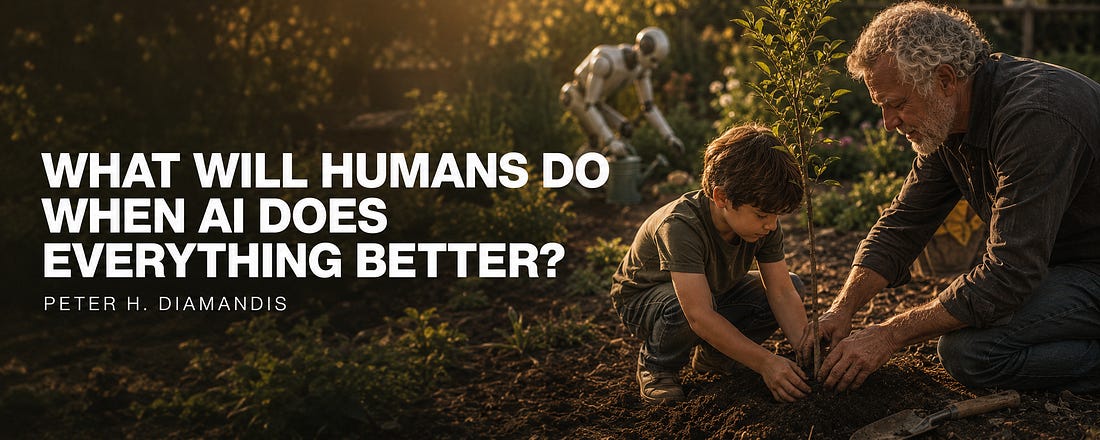
What Will Humans Do When AI Does Everything Better?
This is the ultimate question in a world with advanced AI:
What Will Humans Do When AI Does Everything Better?
A Brainstorm on Purpose, Meaning, and the Post-Work Future
 |
THE QUESTION
When AGI can do any cognitive task better than any human, and humanoid robots can do any physical task better than any human, what is left for us? Not economically. Existentially. What gives a human life meaning when there is nothing a human must do that a machine cannot do better?
This is not a question about unemployment. It is a question about purpose. The unemployment problem has a policy answer (universal high income, redistribution, infrastructure). The purpose problem does not. It is the deepest philosophical question of the AI age, and almost nobody is seriously working on it. This document is a first attempt.
“Technology is the means by which humanity takes a vacation from survival”
– Sadguru
HISTORICAL PRECEDENT 1: THE GREEK CONCEPT OF SCHOLÉ
The ancient Greeks had a word for what we are approaching: skholé (σχολή). It is the root of our words ‘school’ and ‘scholar.’ But skholé did not mean school as we know it. It meant freedom from labor, dedicated to intellectual and spiritual pursuit. For the Greek aristocracy, work was for slaves and metics. The citizen’s highest calling was skholé: philosophy, politics, athletics, art, conversation, the Olympic games, the symposium.
Aristotle wrote that ‘we work in order to have leisure.’ Leisure was not idleness. It was the most serious business of life. The Greek word for leisure became the word for intellectual pursuit because the Greeks understood something we have forgotten: the highest human activities are those done for their own sake, not for survival.
The post-AGI world is the democratization of skholé. For the first time in history, everyone can be a scholar, an athlete, a philosopher, an artist. Not because they are aristocrats, but because the machines handle survival. The question is whether we will use that freedom like the Greeks did or like the Romans did (bread and circuses).
HISTORICAL PRECEDENT 2: THE RENAISSANCE PATRON
The Medici family spent 633,000 florins between 1434 and 1471 on patronage. That is roughly $500 million in today’s money. They funded Brunelleschi’s dome, Botticelli’s paintings, Michelangelo’s sculptures, Galileo’s science, and the Platonic Academy in Florence. They did not create the art themselves. They created the conditions for art to exist.
The Renaissance aristocrat did not work in the way we understand work. Their ‘job’ was to be a patron: to identify talent, fund it, protect it, and curate the results. Lorenzo de’ Medici was not a painter or a sculptor. He was a curator of human genius. His purpose was not to produce but to enable, to choose, to direct resources toward the beautiful and the true.
In the post-AGI world, the role of the patron is available to everyone. AI produces. Humans curate. The question ‘what should we build?’ becomes more important than ‘how do we build it?’ The Medici model suggests that curation, patronage, and taste are not lesser activities. They are the activities that created the Renaissance.
HISTORICAL PRECEDENT 3: HOW THE ULTRA-WEALTHY SPEND TIME TODAY
Harvard Business School research on millionaires found that the wealthy spend more time on active leisure (exercise, volunteering, socializing, reading) and less on passive leisure (TV, scrolling) than the general population. The JPMorgan report on ultra-wealthy families identified reading as the single most common habit. Here is how the ultra-wealthy actually spend their days:
• Physical optimization: Personal trainers, golf, tennis, sailing, yoga, home gyms. The body as a project.
• Intellectual pursuit: Reading (the #1 cited habit), writing, learning languages, collecting knowledge.
• Patronage and philanthropy: Funding foundations, museums, universities, scientific research. The Medici impulse persists.
• Curation and collecting: Art, wine, watches, cars, real estate. The act of choosing and assembling.
• Social connection: Dinner parties, clubs, travel with family, mentoring. Deep relationships as the core reward.
• Creative expression: Painting, music, writing, filmmaking. Not for money. For the act of creation itself.
• Exploration: Space tourism (Bezos, Branson), deep sea exploration, extreme sports, adventure travel.
• Spiritual practice: Meditation retreats, philosophical study, religious engagement, seeking meaning.
• Competition: Chess, poker, racing, betting. The drive to test oneself against others, even when money is irrelevant.
• Mentoring and legacy: Passing knowledge to children, building institutions, writing memoirs.
Notice what is absent from this list: none of these activities are ‘work’ in the economic sense. None are done for survival. All are autotelic: done for their own sake. The ultra-wealthy have already arrived at the post-work destination. They are our preview of what everyone will do when AGI removes the necessity of labor. The data suggests they are not bored or purposeless. They are the busiest, most engaged people on Earth. They just are not doing it for money.
10 CATEGORIES OF POST-AGI HUMAN PURPOSE
Drawing from historical precedent, flow psychology, and years of working through this question with the Abundance360 community, here are 10 categories of activity that will give us purpose when AGI can do everything better:
1. THE CURATOR (The Medici Role)
When AI can produce anything, the most valuable human skill is deciding what should be produced. Curation is an act of taste, values, and vision. AI can generate 10,000 images, 10,000 business plans, 10,000 scientific hypotheses. The human decides which ones matter. This is not a lesser role. It is the role that created the Renaissance.
Commissioning art, science, and exploration from AI systems
Curating knowledge: assembling, organizing, and interpreting what AI produces
Setting priorities: deciding which problems AI should solve first
Taste as the new intelligence: the human who knows what is good, beautiful, and true becomes more valuable than the one who knows how to make it
2. THE EXPLORER
AI can process data faster, but humans still want to stand on the mountain. The experience of discovery is not the same as the fact of discovery. AI can map the ocean floor. A human still wants to dive to it. AI can calculate the atmosphere of Mars. A human still wants to walk on it.
Space exploration: the human drive to go where no one has gone, even when AI has already been there
Deep sea, polar regions, caves: physical exploration of Earth’s remaining frontiers
Inner exploration: meditation, psychedelics, consciousness studies, the exploration of subjective experience
AI can tell you what is there. Only you can experience being there. The experience is the point.
3. THE ATHLETE (Mental & Physical)
When chess engines surpassed human chess players in 1997, more people played chess than ever before. When AI drives cars better than humans, more people will drive cars for pleasure. The point of sport is not to be the fastest. It is to test yourself against your own limits. AI being better does not diminish the experience. It liberates it from the pressure of competition for survival.
Physical sports: the body as instrument, pushed to its limits for the joy of mastery
Mental sports: chess, poker, strategy games, competitive programming (against other humans)
Esports and competitive gaming: human-vs-human competition, even when AI is superior
The Olympics as the model: we do not watch because humans are the fastest possible. We watch because a human achieved something extraordinary.
4. THE CREATOR (Amateur in the Original Sense)
‘Amateur’ comes from the Latin amare: to love. The amateur creates for love, not money. In the post-AGI world, everyone is an amateur. AI produces better art, better music, better writing. But humans will still create because the act of creation is itself the reward. Csikszentmihalyi’s research on flow shows that the deepest happiness comes from autotelic activity: activity that is its own purpose.
Painting, sculpture, music, writing: not to compete with AI, but for the flow state of creation
Gardening, cooking, craftsmanship: making things with your hands for the satisfaction of making
Building physical things: woodworking, pottery, textile arts. The hands want to work even when the mind doesn’t need to.
The journey is the destination. AI produces the result. The human experiences the process.
5. THE RELATIONSHIP BUILDER
AI can simulate empathy. It cannot be a friend. The deepest human need is connection with other consciousnesses. In the post-AGI world, relationships become the primary currency. Not because nothing else is valuable, but because relationships are the one thing that cannot be outsourced to a machine.
Deep friendship: the kind that requires decades of shared experience
Family: raising children, grandparenting, family traditions, intergenerational knowledge transfer
Community building: creating and maintaining social fabric, neighborhoods, cultural groups
Mentoring: passing wisdom (not information) to younger generations
Love: the most irreducibly human experience. AI can simulate it. It cannot live it.
6. THE PHILOSOPHER
The Greeks invented philosophy because they had skholé. When survival is handled, the deepest questions become the most urgent. What is consciousness? What is good? What is beautiful? What should we want? AI can answer ‘what is.’ Humans must answer ‘what should be.’ The philosophical question becomes the engineering question in the post-AGI world.
Ethics: what should AI be allowed to do? What should we want it to do?
Aesthetics: what is beautiful? What is worth creating?
Meaning: what is a good life? What is worth living for?
Governance: how should we organize society when labor is unnecessary?
The unexamined life becomes the only life worth examining when survival is guaranteed.
7. THE PATRON AND PHILANTHROPIST
The Medici model scaled to everyone. In a world of abundance, everyone has resources to direct. Patronage becomes a universal activity: identifying what deserves support, funding it, watching it grow. The XPRIZE model: incentivizing the outcomes you want to see in the world.
Funding science, art, exploration, and social causes (even at small scale)
Incentive prizes: designing competitions that direct AI and human effort toward meaningful goals
Angel investing in human creators: backing the people who still want to make things by hand
The democratization of patronage: crowdfunding at scale, directed by human taste not algorithmic optimization
8. THE STORYTELLER
AI can generate stories. But stories are not about the text. They are about the shared experience of meaning-making. A story told by AI is data. A story told by a human to other humans is connection. The campfire does not become obsolete because we have electric lights. We still sit around it.
Personal narrative: sharing lived experience, memoir, oral history
Myth-making: creating the stories that give a community its identity
Humor: comedy is the most irreducibly human art form. AI can write jokes. It cannot understand why they are funny.
The human story: interpreting and narrating the experience of being human in an age of machines
9. THE PARENT AND EDUCATOR
Fei-Fei Li told Huberman: ‘I always have hope for kids. They are curious.’ In the post-AGI world, education is not about information transfer (AI does that better). It is about character formation, value transmission, and helping children discover what they love. The Socratic method becomes the only pedagogy that matters.
Raising children: not to be workers, but to be full humans
Teaching wisdom, not knowledge: AI has knowledge. Humans have wisdom about what to do with it.
Character education: courage, kindness, resilience, curiosity. These cannot be trained by AI.
The parent as guide: helping children navigate a world where anything is possible, which means the skill of choosing becomes paramount
10. THE HEALER
AI will diagnose better than any doctor. Robots will perform surgery better than any surgeon. But healing is not the same as curing. Healing is the human act of being present with suffering. A nurse holding a hand. A friend sitting with the dying. A community rallying around the broken. AI can cure. Only humans can heal.
Emotional healing: presence, listening, empathy, the human warmth that no algorithm replicates
Community care: building support systems for the vulnerable
End-of-life companionship: the most human of all activities, being with someone as they die
Spiritual care: tending to the soul, however defined, in a world where the body is handled
THE FLOW ARGUMENT: WHY BEING WORSE THAN AI DOESN’T MATTER
Csikszentmihalyi’s research on flow states reveals something critical: the deepest human happiness comes from activities where challenge matches skill, where attention is fully absorbed, and where the activity is autotelic (done for its own sake). Flow is not about being the best in the world. It is about being fully alive in the moment.
A runner does not stop running because a car is faster. A chess player does not stop playing because Stockfish is better. A painter does not stop painting because AI generates images in seconds. The experience of mastery, of flow, of being fully present in the act, is not diminished by the existence of something better. It is liberated from the need to compete.
This is the key insight: the post-AGI world does not eliminate human purpose. It eliminates the confusion between purpose and productivity. For 10,000 years, we have equated meaning with work because work was necessary for survival. When survival is guaranteed, we can finally discover what meaning actually is. And the answer, based on every historical precedent from ancient Greece to the modern ultra-wealthy, is that meaning comes from autotelic activity: things done for their own sake, with full presence, in community with others.
THE DANGER: BREAD AND CIRCUSES
The Roman aristocracy also had skholé. They chose bread and circuses. Gladiator combat, chariot racing, vomitoriums, and decadence. The Greeks used leisure to create philosophy, democracy, and the Olympics. The Romans used leisure to entertain themselves to death. The same freedom produced civilization in one case and collapse in the other.
The post-AGI world faces the same fork. On one path: universal skholé. A world of philosophers, artists, athletes, explorers, patrons, and relationship builders. A second Renaissance, but this time for 8 billion people. On the other path: universal bread and circuses. Endless AI-generated entertainment, dopamine optimization, virtual reality escapism, and the slow atrophy of human capability.
The difference between the two paths is not technology. It is culture. It is what we value. It is what we teach our children. It is the stories we tell about what a human life is for. The Greeks had Homer. The Renaissance had Petrarch. What stories will we tell in the post-AGI age?
THE ABUNDANCE FRAME:
This question connects directly to the ‘When We All Become Wealthy’ newsletter I sent out last week. The millionaire lifestyle demonetizes by 2031. But the question that newsletter didn’t answer is: once everyone has the millionaire lifestyle, what do they DO with it? The ultra-wealthy today give us the answer: they pursue health, relationships, learning, patronage, exploration, competition, creation, and spiritual growth. Not because they have to. Because those are the activities that make a human life feel meaningful.
The abundance thesis has always been about more than material goods. It is about the liberation of human potential. When survival is handled, when health is optimized, when intelligence is free, the question shifts from ‘how do we survive?’ to ‘how do we flourish?’ That question has been answered by every civilization that achieved leisure: the Greeks, the Renaissance Italians, the Enlightenment philosophers, and today’s ultra-wealthy. The answer is always the same: pursue what you love, build relationships, create beauty, explore the unknown, and seek wisdom.
These are the challenges my Abundance360 members are already building for. And let me be clear, the post-AGI world is not the end of human purpose. It is the beginning. For the first time, everyone gets to answer the question: what would you do if you could do anything? The answer to that question, multiplied by 8 billion people, is the most exciting future I can imagine.
To a future of abundance,
Peter
Tuesday, August 11, 2026
Monday, August 3, 2026
OpenAI's Astra JUST solved math...
With AI solving math problems that have eluded mathematicians for many decades, we really are in the run-up to the technological singularity.
Sunday, July 26, 2026
Wednesday, July 22, 2026
Monday, July 20, 2026
Sunday, July 19, 2026
Saturday, July 18, 2026
Civilization will be very different soon...
An era of abundance could lead to the extinction of our species?
Friday, July 17, 2026
From Peter Diamandis: Science Fiction Is a Self-Fulfilling Prophecy
Star Trek’s communicator became the flip phone. Its PADD tablet became the iPad. Its tricorder is now a real clinical device you can hold in your hand — I know, because I ran the XPRIZE that built it. That’s not a run of luck. Humans build what they first imagine, which means fiction is the R&D department of civilization. The problem: for two generations our most vivid, most-watched, most-loved fiction has been dystopian. We have been running a global simulation of failure and calling it entertainment. I think that’s a design flaw, and I’m working on fixing it.
Martin Cooper made the first handheld cellphone call in 1973. He was an engineer at Motorola. He has said, out loud and on the record, that the thing he was chasing was the communicator from Star Trek. He watched Captain Kirk flip open a little device, talk to his ship, and snap it shut, and he decided that object should exist in the real world. So he built it.
A piece of set dressing written to solve a screenwriting problem vs. the question ‘how do you get Kirk to talk to the Enterprise without a phone booth on an alien planet’, became the seed of a $500 billion industry. The flip phone was Star Trek fan fiction rendered in plastic and silicon.
It keeps happening. The PADD, the flat glass tablet the crew carried around, showed up in 1987 on The Next Generation. Steve Jobs put the iPad in your hands in 2010. The tricorder — that handheld medical scanner Dr. McCoy waved over sick crew members — is no longer a prop.
In 2012 I launched the Qualcomm Tricorder XPRIZE to make McCoy’s scanner real. Five years and 300-plus teams later, a family-run team out of Pennsylvania — an ER doctor named Basil Harris and his brother George, working out of their basement — won it. Their device, DxtER, could diagnose 13 medical conditions and monitor five vital signs, no doctor in the room. A brother-and-brother team beat the giants because they’d grown up wanting to build Star Trek. The prop became an FDA pathway.
Wednesday, July 15, 2026
The Alzheimer's Breakthrough Nobody Is Talking About
A blood test can show signs of Alzheimer’s 20 years before symptoms hit. I want that test.
HUMAN Stem Cells Have Reversed Age In Monkey's with ZERO Side Effects
15 more years? I can live with that. It should allow us to live long enough to live indefinitely.
Saturday, July 11, 2026
Friday, July 10, 2026
Thursday, July 9, 2026
Wednesday, July 8, 2026
Germany modernizes it's windmills
Germany's first generation of commercial wind turbines was installed in the 1990s — small machines of 100 to 500 kilowatts that stood 40 to 60 metres tall and were considered remarkable at the time. By the early 2020s, these turbines had reached end of life, and Germany faced a decision about the land they occupied: decommission and restore, or repower with modern equipment that could multiply output dramatically on the same footprint.
Repowering won. Germany's repowering programme, supported by streamlined permitting that waives the full environmental impact assessment requirement for like-for-like site replacements, has replaced thousands of first-generation turbines with modern machines generating 6 to 8 megawatts each — 60 to 80 times the output of the original equipment on the same land, using the same grid connections, often the same access roads, and in many cases the same concrete foundations with structural reinforcement.
The productivity multiplier is extraordinary. A site that previously generated 600 megawatt-hours per year from three 100-kilowatt turbines now generates 40,000 megawatt-hours from a single 6-megawatt replacement. The land use is identical. The noise profile is similar or lower due to modern blade aerodynamics. The visual impact is similar — one taller turbine instead of three shorter ones. The electricity output is 67 times higher.
Germany's wind industry is not just growing by adding new sites. It is rebuilding itself on the sites it already has, multiplying output without multiplying footprint.
Source: German Wind Energy Association (BWE) & Bundesnetzagentur, 2024
Friday, July 3, 2026
Sunday, June 21, 2026
The Next 5 Years: A Supersonic Tsunami
The Next 5 Years: A Supersonic Tsunami
GENIUS FOR LESS THAN A CUP OF COFFEE
Start with the price of intelligence, because it is collapsing faster than anything in the history of technology. According to the Stanford AI Index, the cost of tokens dropped 280x collapse in 24 months. For frontier models, the price has been dropping about 10x every single year, from $20 to about $0.40 per million tokens. Not 10% cheaper. Ten times cheaper, annually.
“We are past the event horizon; the takeoff has started. Humanity is close to building digital superintelligence.”
— Sam Altman, OpenAI
Source: Stanford AI Index 2025 (GPT-3.5-level inference, $/million tokens).
Now stack that against the AGI race itself. Dario Amodei has said a system amounting to “a country of geniuses in a datacenter” could come online as early as late 2026 to 2027. Elon predicts AGI before the end of this year. Whatever month it lands, the meaningful event is recursive self-improvement: AI that designs better AI, on a loop, with each turn faster than the last.
Soon thereafter comes artificial superintelligence (ASI): a single system more capable than the combined intellectual output of all of humanity, across every domain at once. Elon told me he expects “digital intelligence to exceed the sum of all human intelligence by around 2031.” One mind, smarter than eight billion of us put together, available for pennies.
The implication is brutal and beautiful at once: every knowledge job built on “I know something you don’t” gets repriced overnight, while every founder, researcher, and dreamer suddenly commands a research staff of a thousand PhDs for the price of lunch. The moat stops being what you know and becomes what you choose to point that intelligence at.
“It blows my mind multiple times a week. Just when I think ‘wow,’ two days later, more wow. Exponential wow.”
— Elon Musk, on the Moonshots podcast
THEN AI SOLVES EVERYTHING…
Point that intelligence at the hardest open problems we have: math, physics, chemistry and biology. As my Moonshot Mate Alex Wissner-Gross says, “we are about to speed-run every science fiction movie and solve-everything.” AI already proves theorems, predicts the structure of 200 million proteins, and designs novel molecules from scratch. Now run it 1,000x faster and 280x cheaper.
We are about to compress centuries of discovery into a handful of years: room-temperature superconductors, new battery chemistries, materials that don’t exist in nature, drugs designed atom-by-atom for a single patient’s tumor. Every one of those breakthroughs creates wealth. It saves a life, extends a life, or quietly turns last year’s miracle into this year’s Tuesday. The discoveries will arrive faster than any of us can read the headlines announcing them.
“After powerful AI, we will make all the progress in biology and medicine in a few years that we would have made in the whole 21st century.”
— Dario Amodei, Anthropic (“Machines of Loving Grace”)
Here’s the implication: the bottleneck on progress flips. For all of human history, the scarce resource was brainpower (i.e., enough brilliant minds, enough time, to chase down a hypothesis). When that becomes infinite and nearly free, the constraint moves to the physical world: how fast can we run the experiments, build the reactors, fabricate the chips. Atoms become the bottleneck, not ideas. The winners of the next decade will be the people who can move atoms as fast as AI moves bits.
HOLLYWOOD IN YOUR POCKET, AND A CONVERSATION WITH ANYONE
Within the next two years you’ll stream a full feature film generated on demand (your mood, your cast, your language) for the cost of a search query. The marginal cost of a blockbuster falls toward zero.
Stranger still, you’ll sit down with anyone. Einstein to walk your daughter through relativity. Marcus Aurelius for a 2 a.m. talk on how to live. A living celebrity rendered so faithfully you forget it’s software. The line between a real person and a digital persona blurs to the point that “AI personhood” stops being a sci-fi punchline and becomes a question courts and legislatures actually have to answer.
And this reaches past entertainment. A child anywhere on Earth gets a patient, brilliant tutor that costs nothing, the greatest equalizer in the history of education. But you can no longer trust that the face on your screen is real, and “Who owns your likeness after you die?” becomes a live legal fight. Abundance and disruption, on the same wave.
THE ROBOTS ARE COMING HOME: BY THE HUNDREDS OF MILLIONS
Here is where the numbers get truly strange. A Tesla Optimus is targeted to cost $20,000 at scale; Tesla is openly scaling to build one million units a year. 1X’s Neo is priced at $20,000, or $499 a month. Unitree’s G1 already sells for about $13,500. Analysts expect capable consumer humanoids at $10,000–$20,000 by 2030.
Source: Elon Musk projection (100M–1B humanoids by 2031); illustrative ramp.
Financed over five years, a $20K robot runs roughly $300 per month… $30 per day, well under a dollar an hour for a machine that never sleeps. Elon’s projection: 100 million to 1 billion humanoid robots by 2031. The intelligence inside them is the same frontier model collapsing in price above, so your robot won’t just fold laundry. It will cook like a Michelin chef working from ten thousand recipes, conduct a surgery with sub-millimeter precision, tutor your kids, and care for your aging parents with patience no exhausted human can sustain at 3 a.m.
“In three years, at scale, there will be more Optimus robots that are great surgeons than there are surgeons on Earth.”
— Elon Musk, on the Moonshots podcast
The result is the biggest labor shift since the tractor emptied the farms. Physical work, the thing that has defined the human economy since we stood upright, starts trending toward free, toppling the cost of building, manufacturing, and caregiving. The same robots that displace a task give a billion people their hours back. The hard question every society now has to answer: when work is optional, where do meaning and dignity come from?
YOUR BODY BECOMES EDITABLE CODE
This is the part I care about most. Biology is becoming readable, then writable, something we debug, patch, and rewrite. Disease stops being fate and becomes an engineering problem. Aging itself moves onto the list of things we can slow, halt, and one day reverse.
I watch the early version of this every day at Fountain Life, the company I co-founded to catch disease before it catches you. Roughly two of every ten members walk in feeling perfectly healthy and walk out with a life-saving diagnosis: a stage-1 cancer, an aneurysm quietly waiting to kill them. That’s today’s technology, before AGI. Add five years of superintelligence on top and “your healthspan” (the single most valuable asset you own) gets the upgrade of the century.
“I think we can cure all disease with the help of AI. The end of disease is within reach, maybe within the next decade.”
— Demis Hassabis, Google DeepMind / Isomorphic Labs
The outcome is the one I care about most: longevity escape velocity (LEV) moves from a slide in my keynote to a planning assumption for your life. If we can add more than a year of healthy life for every year you stay alive, then your single most important job right now is simply to not die of something stupid in the interim. To make it to the next breakthrough, and the one after that. My mentor and friend Ray Kurzweil predicts we will reach LEV by 2033. Health stops being the thing you spend wealth on and becomes the foundation that lets you enjoy all the rest.
“A doubling of the human lifespan is not at all crazy, and with AI we may be able to get there in five to ten years.”
— Dario Amodei, Anthropic
THE SKY AND THE STREETS, REINVENTED: AT 20 CENTS A MILE
Look out the window. A human rideshare today costs you roughly $2.00 a mile. Cathie Wood, ARK Invest, projects a Waymo will run about 40 cents a mile by 2030, and Tesla’s purpose-built Cybercab closer to 20 cents. A 10x cut that makes owning a depreciating car parked 95% of the day look absurd.
Above the gridlock, eVTOLs (flying cars, finally real) are crossing from prototype to certified product, turning the empty sky over our cities into open highway. Drones drop our packages, inspect our bridges, and rewire global logistics. Cheap, ubiquitous, autonomous movement on the ground and in the air will rebuilds where we live, how far we’ll commute, and what a city even is.
The implication ripples straight into the largest asset class on Earth: real estate. When a 60-mile commute costs a few dollars and you can read, sleep, or work the whole way, the premium on living near the office evaporates. Land 90 minutes out becomes 20 minutes up. The parking lots and garages that swallow a third of every city center are freed to become parks. We will quietly redraw the map of where humans choose to live.
Source: ARK Invest cost-per-mile projections, 2030 (via Top 10 Metatrends Report).
THE ECONOMY GOES VERTICAL
Now for the number that stops people in their tracks. When I interviewed Elon on the Moonshots podcast, he told me he expects something on the order of a 10x expansion of global GDP within ten years: a world economy climbing past a quadrillion dollars, with the doubling period collapsing from decades to a handful of years.
I’ve known Elon for 26 years. I’ve watched smart people bet against his vision for two decades. They keep losing. So when he throws out a number like that, I don’t laugh. I run the math, and I hand it to the young founders I mentor: if global GDP is heading toward $1.2 quadrillion and only a small handful of people are doing genuinely foundational work, your personal quota (the value you’d need to create just to keep pace) lands near $10 billion. Watching that number register on a 25-year-old’s face in Dave Blundin’s Link Studios is one of my favorite things in the world.
“In the next 18 months we hit 10% GDP growth, and by 2030, triple-digit: 100% GDP growth.”
— Elon Musk, on the Moonshots podcast
This is the engine under everything else: free intelligence, plus tireless robots, plus discovery on fast-forward. This does more than merely improve life. It manufactures wealth at a scale the species has never seen, with no natural ceiling in sight. The hard part was never creating the Abundance. It’s deciding how widely we share it.
“If AI becomes advanced enough to run companies, why not my own? I should be the most willing to do that.”
— Sam Altman, OpenAI
The upshot is the defining political and moral question of the next decade. A quadrillion-dollar economy can lift everyone or concentrate in a few hands. The technology is indifferent… the choice is ours. I’m betting on broad Abundance, because for the first time the size of the pie is effectively unbounded, and a world of empowered, healthy, optimistic people is simply a better market, a more stable society and a better place to live. But it won’t happen by accident. We have to build it on purpose.
Subscribe to:
Posts (Atom)